The Dreadnought
A pre-war voice. Loud enough to be heard over a banjo.
The Six Sides dreadnought takes its cues from the pre-war Martins — the guitars built in the 1930s that became the standard every bluegrass flatpicker has measured against since. That era got something right about how a big guitar should move air, and most of what I do here is an attempt to understand it rather than improve on it.
It is braced with a forward-shifted X, the way those guitars were, which moves the bracing closer to the soundhole and frees more of the top to move. The result is the response the shape is known for — strong fundamentals, a low end you feel as much as hear, and enough headroom that hard playing gets louder instead of getting compressed.
Which is the whole point, if you play bluegrass. This is a guitar that can be heard over a banjo — and any flatpicker who has tried to hold a rhythm part together in a jam knows exactly how much that sentence is asking for. It has to cut without turning harsh, and it has to keep doing it at volume, all night.
Every Six Sides dreadnought is a commission. There is no stock model to order and no production run behind it. What follows is the starting point, not the specification — the spec gets built with you, around how you actually play.
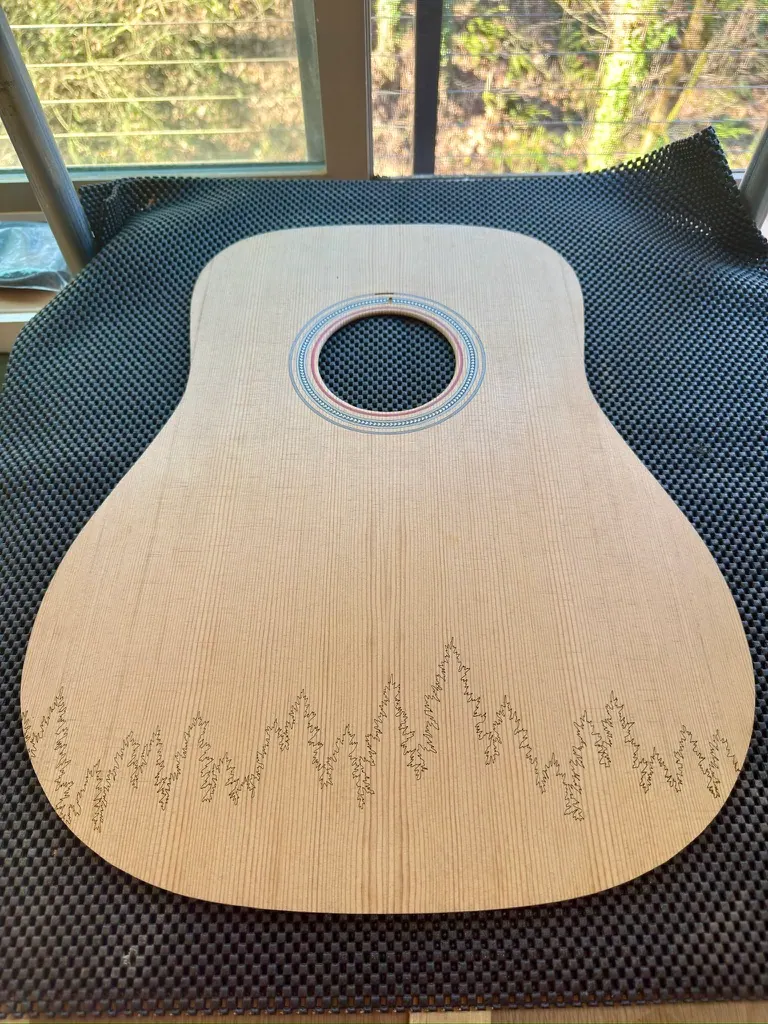
The starting point
- BodyFull-size dreadnought, following the pre-war Martin proportions.
- BracingForward-shifted X, as on the pre-war guitars, voiced by hand for the top in front of me rather than to a fixed pattern.
- TonewoodsChosen together. Spruce tops — Adirondack, Sitka, and others — over Honduran mahogany or rosewood back and sides. Each pairing takes the shape somewhere different.
- FinishFrench polish — shellac, applied by hand with a muñeca, the wound cloth pad the method is built around. It keeps improving after it leaves the bench. Why I use it.
- Build timeApproximately six months, one guitar at a time.
- Delivered withA hardshell case and a full setup for the strings and action you specified.
Scale length, nut width, neck profile, and every aesthetic detail — inlay, binding, headstock shape — are decided during the design conversation. Those are the choices that make a guitar fit a particular pair of hands, and they are not worth guessing at in advance.
Where the wood comes from
A dreadnought is mostly an argument about how a top moves, so the wood is not a place to economize. I buy from the people who do this seriously: Pacific Rim Tonewoods in Concrete, Washington, Hibdon Hardwood in St. Louis, Alaska Specialty Woods on Prince of Wales Island, and a few others.
What they have in common is that they know their own stock. They quarter it, dry it, grade it, and can tell you where a set came from and what it has been doing since. Alaska Specialty Woods works entirely in salvaged old-growth Sitka out of the Tongass, which is about as good as the story gets for a spruce top. Pacific Rim has spent years measuring what they sell rather than guessing at it — their Q-factor data is part of what got me thinking about measurement at the bench in the first place.
None of that guarantees a good guitar. It just means the material is honest, and that when a set does something unexpected under the plane, the surprise is mine rather than the supplier's.
Price
A $1,000 deposit holds your slot and starts the build; it is applied toward the total. Final pricing depends on wood selection and any custom aesthetic work, and is agreed before the deposit is taken.
If the smaller, more focused instrument sounds closer to what you are after, read about the parlor. If you want to see the work itself, the gallery is the honest version — bracing, glue-ups, mistakes and all.
Write to start the conversation, or read how a commission works.