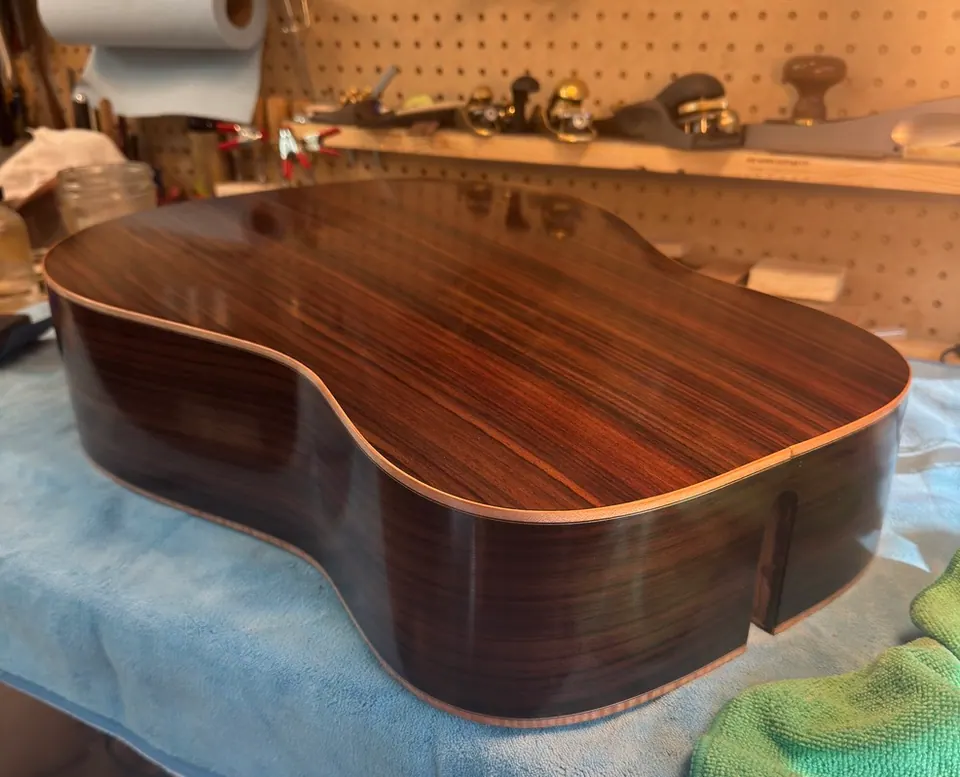
I recently attended the Timber to Tonewood conference with Trevor Gore and Rob O'Brien. I went expecting to learn more about wood. I came away thinking about judgment. What I kept turning over was the balance between what can be measured and what still has to be felt.
That balance is not a new problem. Builders have always listened to wood, flexed it, weighed it, tapped it, and tried to remember what the last piece taught them. What is changing is the amount of information available before a board becomes part of an instrument. The work at Pacific Rim Tonewoods, including the Q-factor data they shared, is a good example of that change.
A number is not a verdict
Q factor is one way of describing how a material holds and loses energy when it vibrates. It gives you a window into damping: how sharply a piece responds, and how quickly that response gives itself back to the air. That is valuable information. It is more precise than calling a board lively or sleepy, and more portable than relying on a memory of what lively meant last Tuesday.
But a number is not a verdict. A Q factor does not tell you that a piece of spruce is good or bad in the abstract. It tells you something about that piece, under a particular kind of measurement, at a particular point in its life. The moment it becomes a guitar, it enters a larger system: thickness, shape, bracing, glue joints, finish, strings, air, and the player holding it. The data is real. It is simply not the whole event.
The temptation to choose sides
Craft has a familiar argument with itself here. One side distrusts numbers because a guitar is not a spreadsheet. The other distrusts instinct because instinct can become a polite name for habit. Both sides are right often enough to make the argument last.
There is a romantic version of the builder who can hold a board, close his eyes, and know everything that matters. There is also a modern version of the builder who believes the right measurement can remove judgment from the process entirely. I do not believe either one. The first confuses experience with magic. The second confuses information with understanding.
I have worked at both extremes
This argument is not confined to the shop. I have spent my career on both sides of it.
At Netflix, almost everything is measured. Decisions are expected to be defensible with evidence, and an opinion that cannot be tested is treated as a hypothesis rather than an answer. It is a clarifying way to work, and the bar is not vague: if a change cannot move the needle a percent, it is hard to justify shipping it. That kind of discipline keeps you honest. It also makes big changes harder to make. A small, safe tweak can usually clear that bar right away. Something genuinely new often cannot. Its first version is rough, and it is being judged by metrics that were designed for the thing it would replace. So the small improvements keep getting approved, and the larger idea waits for proof it cannot produce until someone builds it anyway. And measurement is never free: you get what you instrument, and the things nobody thought to measure quietly stop counting.
At Disney, and at the other entertainment studios I collaborated with, the instinct is the instrument. Creative decisions are trusted, craft and taste carry real authority, and people are comfortable saying that something is not right yet without producing a chart to prove it. That is not sloppiness. It is a long institutional memory of what an audience feels, held by people who have been corrected by audiences many times. These are businesses that have been reading rooms for a hundred years.
Neither culture is naive about the other. What I took from working in both is that the two approaches fail in opposite directions. Measurement fails by optimizing something true but small. Instinct fails by mistaking familiarity for judgment. The work is knowing which failure you are closer to today.
What the data is for
Good data gives instinct something to answer to. It lets you compare your impressions with repeatable observations. It can expose a preference you have mistaken for a principle. It can show that two pieces of wood you thought were opposites share more than you expected, or that a familiar species contains a much wider range than its name suggests.
It also makes a builder more honest about uncertainty. If I choose a top because I like the look of the grain, that is a legitimate choice, but it is not the same as choosing it because I know how it will behave acoustically. If I measure a board and then ignore what my hands and ears are telling me, that is not rigor. It is just another kind of superstition. It is the belief that the instrument can be reduced to the instrument's inputs.
The best use of measurement, to me, is not to make the decision automatic. It is to make the question better. What am I hearing? What am I assuming? What would I expect this piece to do, and what evidence would change my mind? Those are much more useful questions than whether the number is high enough to make the wood special.
What instinct is for
Instinct is not the opposite of science. At its best, it is compressed experience. It is the hand recognizing a stiffness before the mind has named it, or the ear noticing that a tap has a kind of resistance in it. It is pattern recognition built from repetition, and it can be remarkably good when it has been corrected by consequences.
That last part matters. Instinct becomes trustworthy through feedback. The builder makes a judgment, finishes the guitar, hears the result, and remembers what was right and what was wishful thinking. Over time, some impressions survive that test. Others quietly fall away. Without that loop, instinct is just preference wearing a shop apron.
This is where the science helps. It gives experience a second witness. It does not replace the ear; it helps train it. The measurement can tell me where my intuition is reliable and where it is telling a story I want to believe.
The handoff
I think the useful sequence is simple: measure what can be measured, listen to what can be heard, and stay suspicious of any method that claims to be complete.
Science is especially good at boundaries. It can tell us what a material is likely to tolerate, how it compares with another piece, and which variables are worth paying attention to. Instinct is especially good at the handoff from material to instrument. That is the moment when a board stops being a data set and starts becoming part of a particular guitar for a particular player.
That handoff is not a failure of the numbers. It is the reason the numbers are useful. If the work were fully predictable from a table, there would be no need for a builder at the bench. There would be a procurement department and a machine waiting at the other end.
Still listening
What I took from Timber to Tonewood was not that I need to choose between measurement and instinct. It was that I need to be more deliberate about when I use each one.
I want data early, when I am trying to understand the material and make a responsible choice. I want instinct later, when the piece has become part of a structure and the structure has begun to speak. I want the two to argue with each other often enough that neither one becomes comfortable.
Charles Fox gave me the sentence I keep coming back to: “It's all about the music.” That is the standard underneath the measurements and the instincts. The point of understanding the wood is not to win an argument about it. It is to make an instrument that lets the player create. It should let them sing, play, and feel.
A guitar is too complicated to be captured by one number, and too physical to be understood without any numbers at all. The work lives in the space between those truths. Measure carefully. Listen closely. Then keep listening after the measurement says you are done.