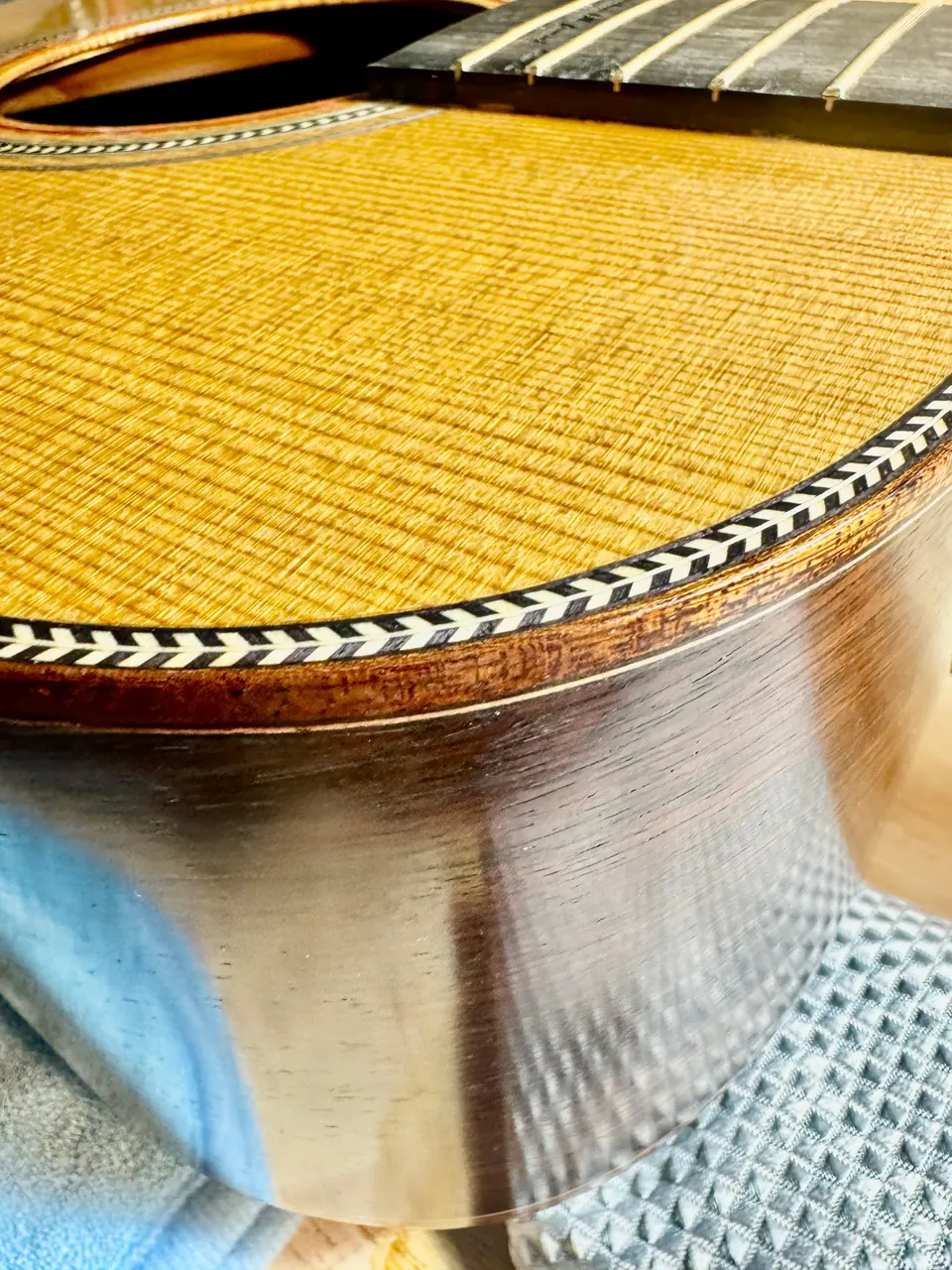
I've written before about the finish I chose - why French polish feels honest to me. This is about the finish I didn't choose, and why it became such a powerful word in the guitar world.
Because if you spend any time around serious guitars, you hear the word nitro a lot, usually with reverence. Nitrocellulose lacquer is the finish of the golden era - the prewar Martins, the fifties Gibsons - and in the boutique world it's shorthand for "done right."
I get it. Some of my favorite instruments ever made are wearing it. But the story of how it got there is stranger than the reverence suggests - or at least it was stranger than I expected.
Surplus guncotton
When I went looking for the history, I expected guitar shops and old ledgers. What I found was Guitar Center's least likely ancestor: the munitions industry.
Nitro wasn't developed for instruments, or even for wood. It's cellulose treated with nitric acid - the same basic chemistry as guncotton - and after World War I, the chemical industry had enormous nitrocellulose capacity and suddenly no war to feed it. DuPont pointed that capacity at coatings, and its Duco lacquers landed first with its biggest customer, General Motors. The first products sprayed with nitrocellulose lacquer weren't guitars. They were 1924 Oaklands.
The pitch was never beauty. It was speed. Varnishing a car took weeks; spraying lacquer took hours. The guitar factories of the twenties signed on for the same reason - nitro replaced varnish and French polish because it moved inventory. As far as I can tell, nobody sat down and decided it was what spruce deserved. It was what the paint salesman was selling that decade, and it happened to look good. Sometimes that's how traditions start.
What it does with time
Ask anyone with an old lacquered guitar. The finish checks - that web of fine cracks - because the plasticizers that keep it flexible slowly migrate out, and the film shrinks and gets brittle. It yellows, not always evenly. It keeps off-gassing for years, which is why it melts against guitar stands and case linings. And it wears through wherever you touch it.
The vintage market has turned all of this into charm - checking as authenticity, wear as mojo. And honestly, on a '37 D-28, it is charming. I won't pretend I'm immune. But nitro's best day is the day it leaves the spray booth, and there's an entire relic industry devoted to faking the decline. I don't think that's an accident.
The slow work
I should be honest about my side of the trade too. French polish is slow. Not artisanal-slow, marketing-slow - actually slow. It's a person in a room, making small circles with a muñeca for weeks, and some of those sessions are not romantic at all. There are evenings when I'd trade a lot for a spray gun and a cured finish by morning.
But somewhere in the repetition the surface stops feeling like a coating and starts feeling like part of the instrument. I don't fully understand why a film this thin does what it does. It still feels a little magical to me, and I've stopped apologizing for that.
Shellac runs the clock backwards
Everything here gets French polish - shellac, applied by hand with a muñeca, the wound cloth pad the method is built around, and the finish nitro replaced a century ago. Not for nostalgia. It's just the only finish I know of where time seems to be on your side. A French polished guitar isn't really done when the last pad session ends. It's done months later, and then it keeps going.
The film keeps tightening. The last traces of alcohol take months to leave, and as they go the film shrinks and pulls down onto the wood and into the pores. A finish that looks a little soft at two weeks looks crisp at three. The old polishers knew this - they'd finish an instrument, set it aside, and deliver later. The waiting was part of the job.
The resin keeps curing. Shellac slowly cross-links, getting noticeably harder over its first year - at least that's how I understand the chemistry, and it matches what I see on the bench. While nitro spends decades losing plasticizers and going brittle, shellac spends its first year getting stronger. That's a trade I find easy to like.
The look keeps deepening. Shellac's refractive index is close to wood's, so a thin film reads as depth rather than coating. As it settles, more comes through. The medullary rays in a quartersawn spruce top - that faint silk running across the grain - show more at month six than month one. Rosewood does the same thing, just darker. And handling adds its own soft burnish over the years; old French polished instruments have a glow in the touched places, the finish keeping a record of hands. Nitro wears through where you touch it. Shellac seems to light up there instead.
They age as a pair
Spruce starts out nearly white, and a decade of light turns it honey and amber. Rosewood settles and deepens. Shellac warms right along with them, so the wood and finish drift the same direction, together. To my eye a French polished guitar at year five is simply better looking than the day it was strung up. (The koa on my ukuleles might be the best demo of all - it darkens fast and the finish keeps pace - but it works the same on everything that leaves this bench.)
And when a French polish eventually needs attention - they all do - the repair can be nearly invisible. New shellac dissolves into old with little or no witness line. I learned the other side of this the hard way, repairing the finish on my 1999 Collings D2H, a guitar I bought at McCabe's in Santa Monica and love without reservation. Collings' lacquer work is as good as it gets - which was exactly the problem. Every touch-up on nitro is a patch trying to impersonate the original, and the original never fully accepts it. I got it close. But under raking light, the lacquer never quite forgot what had happened. That repair changed how I think about finishes more than any book did. Shellac rarely puts you in that position; the new material simply becomes the old.
Where that leaves things
None of this makes nitro a bad finish, and it certainly doesn't make the people spraying it wrong. Plenty of builders I admire use it beautifully, and the great lacquered guitars are great guitars. It's a fine finish for a factory - it sprays fast, cures fast, ships fast, exactly what it was invented to do, for cars. French polish takes weeks of handwork and can't be hurried, which is precisely why the factories dropped it. I understand the choice they made. I might have made it too.
But I build one guitar at a time, for one person, and at that pace nitro's advantages don't buy me anything. So I use the slow finish - the one that treats time as an ingredient instead of a threat. The commission list here runs long anyway. Turns out the finish doesn't mind waiting either.