A note on the name.
For sale: baby shoes,
never worn.
Six words. A whole story. For decades the line has been attributed to Ernest Hemingway — a bet won on a napkin at a long lunch with fellow writers. The story is almost certainly a myth. Versions of it were published in 1906, when Hemingway was seven years old. The attribution to him first appeared in 1989, nearly thirty years after his death.
But the story kept being told anyway — because it was beautiful, because it felt true, and because no one else had a better claim.
That's itself a luthier's inheritance. Every acoustic guitar built here sits on a tradition no single person invented: ladder bracing, X-bracing, the dreadnought, the 000, the voicing of a spruce top. I build on what was passed down, and I try to add one good thing.
Six Sides is named for the discipline of that six-word story: say the necessary thing, remove everything else. It's a standard for how the guitars are built, how the brand sounds, and how customers are treated. If a detail doesn't earn its place on the instrument — a binding line, an inlay, a word in a sentence — it shouldn't be there.
About David
Six Sides is built by David Ehlers in Portland, Oregon. He's been a product designer for more than twenty years, with work at Disney, Netflix, ABC, Cisco, The Academy Awards, and a handful of venture-backed companies. He started building guitars the way a lot of people do — because he wanted one he couldn't find. The first was a StewMac kit. The second was a pre-war-style dreadnought built from scratch. The third was better than the second.
He also builds LumiTuner, a precision strobe tuner app used at the Six Sides bench and by luthiers elsewhere. The guitars and the tuner are, in a real sense, the same practice expressed two ways: one in wood and hide glue, the other in code and pitch detection. The discipline is the same in both.
The shop
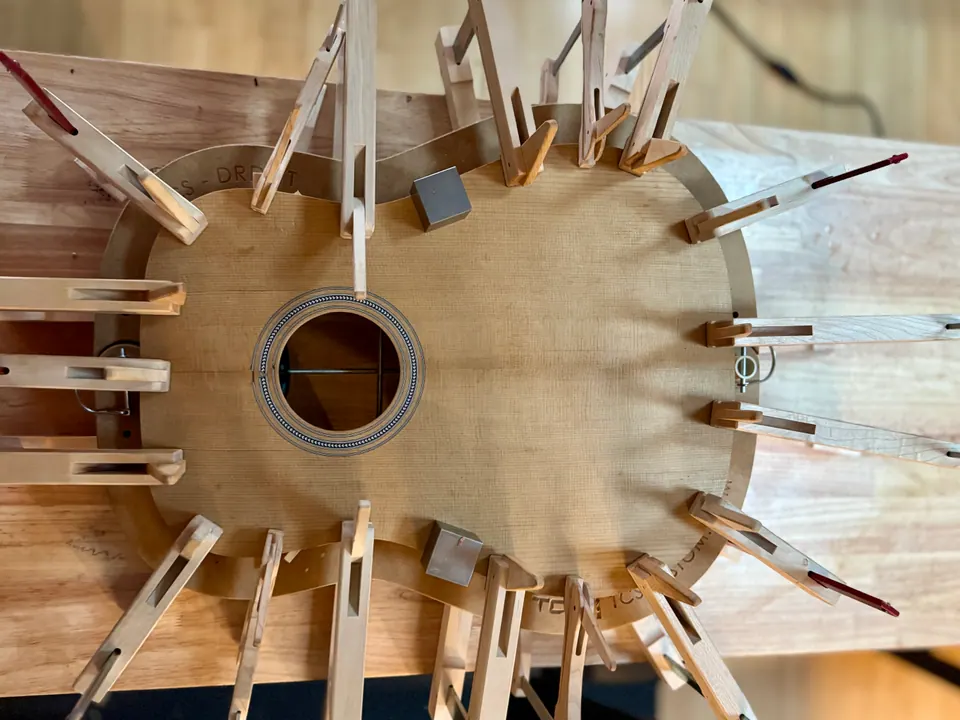
One builder. One bench. Portland, Oregon. Between six and ten guitars a year, no more. That ceiling is intentional — it's the rate at which one person can build carefully and still have time to think about what they're building.
Commissions only. Every guitar is made for a specific player based on a real conversation about what they need the instrument to do. No two builds are identical, and none are speculative.